Odoo lets an automotive aftermarket business run its online store, sales, purchasing, warehouse, workshop and accounts on one platform, and it makes sure it has vehicle fitment management to reduce errors.
Explore Odoo for Automotive Aftermarket>>
How does Odoo run an online auto parts store?
Odoo’s own eCommerce app sells to consumers and trade buyers from one site, and the aftermarket layer adds vehicle search so every shopper sees only the parts that fit.
What Odoo eCommerce gives an auto parts seller as standard:
- One web store for retail and B2B: trade customers log in and see their own price list, credit terms and order history
- Products, images, stock and prices come from the same records your warehouse and accounts use, so nothing is uploaded twice
- Live stock on the product page, with “ships from” and back-order rules you set
- Promotions, coupons, bundles (install kits, fluids, hardware) and cross-sell on every product
- Payment providers, shipping rates and labels (UPS, FedEx, USPS, DHL) built in
- Abandoned-cart recovery, customer reviews, SEO fields and a blog on the same site
- Amazon connector for orders and FBA stock; eBay and Walmart through add-on connectors
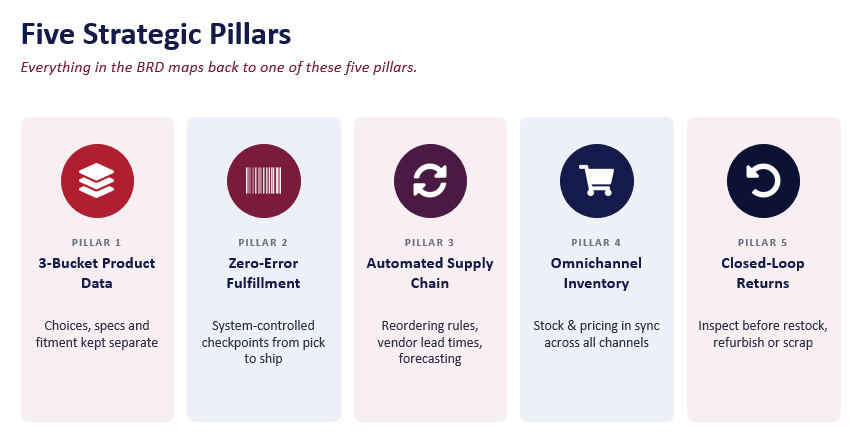
What the aftermarket layer adds on top:
| Capability | What the shopper sees | What it does for you |
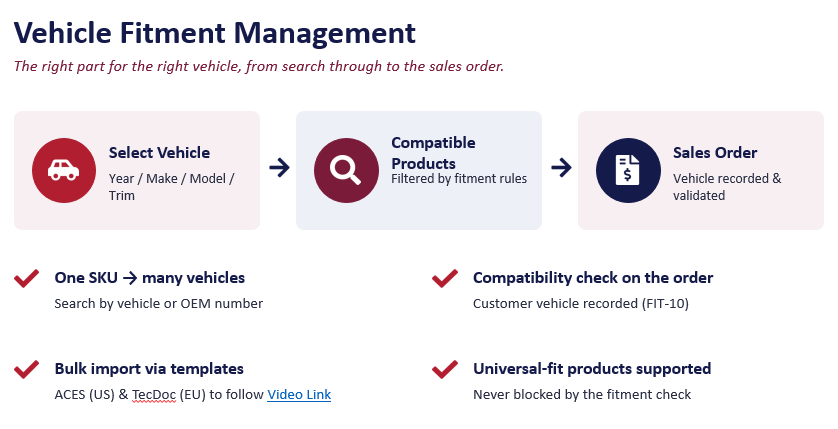
| Year / make / model / engine selector | Picks the vehicle once, in the header | Catalog filtered to fitting parts only |
| My garage | Saves several vehicles to the account | Returning buyers skip the lookup |
| Fit badge | “Fits your 2019 F-150 5.0L, front left” on the product page and in the cart | Position, quantity and notes shown before purchase |
| Cart warning | Flag on any line that does not fit the chosen vehicle | Wrong-fit orders stopped at checkout |
| Search by any number | OE number, competitor number or old number finds your part | Trade buyers order the way they always have |
| Applications list | Every vehicle a part fits, grouped by make and model | Confidence for shoppers who have not picked a vehicle |
| Marketplace compatibility | Same fitment published to Amazon, eBay and Walmart | Listings rank, fewer marketplace returns |
A simple example:
A shop owner opens your site on a phone, selects a 2019 Ford F-150 5.0L, searches “brake pads”, sees two of your products marked as fitting the front axle, adds one, and pays at the dealer price tied to their login.
The order lands in Odoo already allocated to the nearest warehouse, the picking list prints, the carrier label is generated, and the invoice posts when it ships. Nobody re-typed anything, and the part fits.
How does Odoo manage customer service, returns and warranty for Automotive Aftermarket business?
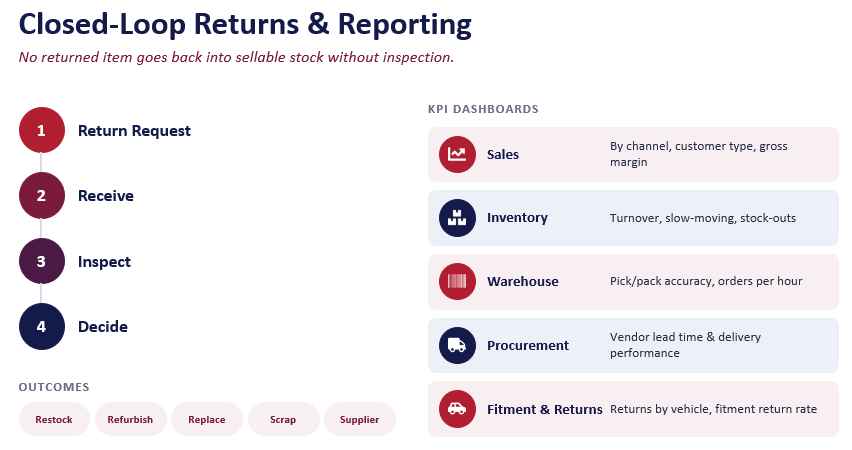
Every ticket, return and claim is linked to the order, the part and the vehicle.
- Help desk and live chat tied to orders
- Return authorisation with reason, inspection and decision (restock, send back to vendor, scrap)
- Warranty claims checked against the policy for that product line, with the failure recorded
- Dealers and installers raise returns and claims through the portal and see the status
How does Odoo handle autoparts sales to garages, dealers and distributors?
Every customer gets their agreed price automatically, from any channel, with no re-typing.
- Price levels for jobbers, dealers, distributors and buying groups
- Promotions with start and end dates
- Minimum advertised price protected on your website so you never undercut your own dealers
- A dealer portal where customers check stock, see prices, place orders and download invoices
- Orders from email, phone, portal, web store, Amazon and EDI retailers land in one list
- Rebates owed to dealers or due from vendors are tracked as you go, not discovered at quarter end
How does Odoo manage purchasing, imports and landed cost?
You know the true cost of a part, including freight and duty, on the day it arrives.
- Reorder points by product and warehouse, with supplier lead times
- Purchase orders, deposits and letters of credit tracked together
- Freight, duty, brokerage and insurance spread across the parts in the container
- Duty rates kept by product and country of origin, so a tariff change shows which shipments it affects
- Price updates proposed when cost moves, approved by finance before they go live
- Suppliers measured on delivery and quality; defective lots claimed back
How does Odoo keep auto parts stock and the warehouse under control?
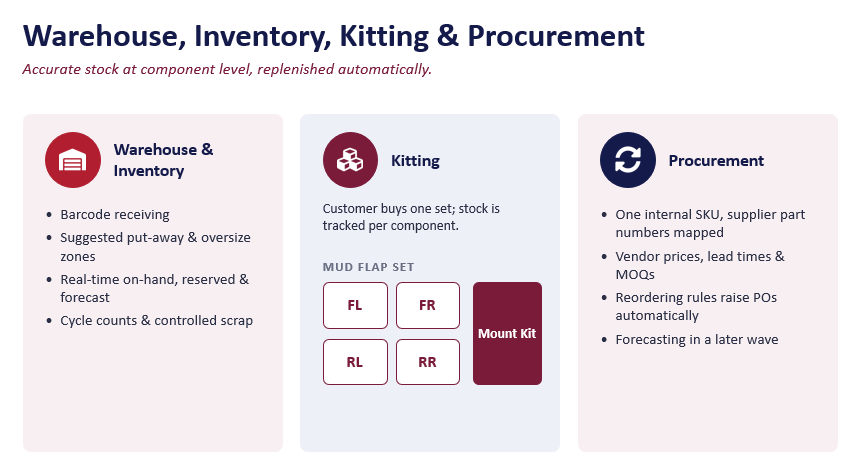
One stock picture across every warehouse, branch and marketplace fulfilment centre.
- Barcode scanning for receiving, put-away, picking and counting
- Stock visible per branch, with transfers between them
- Amazon FBA and third-party warehouse stock shown alongside your own
- Drop-ship orders sent to the supplier automatically
- Cores (old parts owed back to you or to a vendor) tracked like money, with a balance per customer and supplier
- Slow and dead stock reports by product line
How does Odoo manage finance for your Auto Parts aftermarket business?
Invoices, payments, taxes and reports come straight from the operations, with nothing to re-key.
- Customer invoices created from deliveries; supplier bills matched to receipts
- US sales tax calculated automatically; multi-currency for overseas suppliers
- Several companies or brands in one system with group reporting
- Margin by brand, product line and even by vehicle make and model
- Rebates, warranty costs and core balances already in the numbers, not in a side spreadsheet
Businesses that have cleaned up their fitment data report returns falling by around 40%. In a category where one order in five comes back, that is the whole business case.
Why choose Odoo for Automotive Aftermarket Business?
| Before | After |
| Fitment in a spreadsheet or catalog agency portal (DCi, SEMA Data), updated after the part is in stock | Vehicle Fitment Management in Odoo on the product record, required before the part goes live, exported as ACES and PIES per receiver |
| Orders re-typed from Amazon, email, EDI portals and the web store | All orders in one list, automatically |
| Stock counted separately in the store, the listing tool, FBA and the warehouse | One stock figure everywhere |
| Landed cost worked out weeks later in a spreadsheet | True cost known at receipt, duty by HS code and origin |
| Cores, rebates and warranty tracked by memory | Tracked as ledger balances the accounts can see |
| Returns treated as a cost | RMA reason codes used to fix the data |
Want to witness the solution first-hand?
Frequently asked questions
Is Odoo a good ERP for the automotive industry?
For aftermarket parts businesses of 10 to 300 people, yes. Odoo covers the store, sales, purchasing, warehouse, production and accounting as standard, and vehicle fitment, cores and catalog publishing are added on top. Large dealership chains are better served by dealer management systems.
Does Odoo support ACES and PIES?
Not out of the box. The aftermarket layer stores applications against Auto Care VCdb vehicle IDs and PCdb part types, and generates ACES and PIES files per receiver, full or incremental, validated before they go out. You keep your own Auto Care subscription.
Can Odoo show customers which parts fit their car?
Yes. Shoppers pick their vehicle on your website, see a fit badge on each product and get a warning if a part in their cart does not fit. The same check runs on phone orders and in the dealer portal.
Does Odoo work with Amazon and eBay for auto parts?
Odoo connects to Amazon for orders and FBA stock as standard. eBay and Walmart are added through connectors, and vehicle compatibility is published to all of them from the same product data.
How does Odoo deal with import duty and tariffs on parts?
Freight, duty and other charges are added to the cost of the parts when they arrive. Duty rates are stored by product and country, so when a tariff changes you see which shipments are affected and which prices should move.