Why Businesses Are Moving Toward Modern, Cloud ERP Software?
The enterprise software landscape has changed faster than traditional ERP systems could evolve.
Modern businesses demand platforms that adapt, not just automate. A next-generation ERP brings together data, workflows, and intelligence in one unified environment. It’s not simply “cloud ERP”; it’s a connected operational backbone that continuously learns, predicts, and evolves with your organization.
Unlike legacy systems that required custom code for every change, modern ERPs use modular design, embedded analytics, AI assistance, and API-level connectivity to scale across departments and business models. The outcome: faster decisions, leaner operations, and a platform that grows with you, not against you.
The Core Problems Next-Gen ERP Actually Solves
1. Fragmented Information
Legacy systems often create departmental silos. Finance, procurement, and production see different truths.
Next-gen ERP creates a single operational system, linking every transaction, record, and performance metric. Teams no longer debate data; they act on it.
2. Process Gaps and Manual Dependence
When human intervention drives every approval, entry, or follow-up, scalability hits a wall.
Through workflow orchestration and rule-based automation, modern ERPs execute repetitive steps automatically without sacrificing control.
3. Decision Latency
Business leaders struggle not from lack of data, but from delayed insight.
With real-time analytics embedded directly into dashboards, next-gen ERP surfaces variances and patterns as they occur, turning lagging reports into live intelligence.
4. Adaptability to Change
Mergers, new channels, pricing models, or tax rules- legacy systems resist change.
Next-gen ERPs are composable: components can be activated, extended, or replaced without disrupting core processes.
Principles That Define Next-Gen ERP Software
| Principle | Description | Business Outcome |
| Unified Data Model | One database for all functions. | 360° view of customers, inventory, and finance. |
| Automation by Design | Embedded rules & triggers execute tasks automatically. | Lower cost per transaction, fewer manual errors. |
| Intelligence Everywhere | Predictive analytics, anomaly detection, AI assistants. | Proactive decision-making, faster risk mitigation. |
| Composable Architecture | Plug-and-play modules for any function. | Agility to evolve with new business models. |
| Low-Code Flexibility | Graphical tools for workflow or screen design. | Empowered business users, reduced IT backlog. |
| Cloud-Native Scalability | Global access, elastic resources, constant updates. | Resilience, mobility, and simplified maintenance. |
Odoo: A Practical Example of Modern ERP Thinking
Odoo exemplifies the evolution of ERP toward accessibility and intelligence. Its modular framework lets companies start small, CRM, Inventory, or Accounting and expand seamlessly as needs mature.
Key differentiators that align Odoo with next-generation ERP principles:
- Integrated AI Layer (Odoo 19): AI drafting, intelligent filtering, and conversational assistance embedded natively, reducing repetitive user actions.
- Unified Architecture: Every module speaks the same data language, ensuring consistency across CRM, Purchase, and Manufacturing.
- Low-Code Personalization: Functional users can configure workflows, approval chains, and forms without custom code.
- Cloud Collaboration: Real-time access for distributed teams with automatic updates and zero downtime.
For organizations balancing flexibility with control, Odoo provides the agility of SaaS with the depth of ERP.
Real-World Impact: From Manual Silos to Measurable Efficiency
A mid-sized managed service provider faced data silos problem while scaling.
Their operations had outpaced the tools they relied on. Sales teams tracked leads in spreadsheets, project managers monitored delivery through isolated trackers, and invoices were still prepared manually in Excel. As client demand grew, this disconnected setup led to:
- Missed renewals and delayed follow-ups
- Inconsistent pricing across quotes and regions
- Limited visibility into project profitability
- Frequent billing errors and commission disputes
They selected a modular, cloud-based ERP platform, Odoo, to centralize their operations. Starting small, the team deployed CRM, Sales, Project, and Invoicing modules, gradually connecting every business function through defined workflows and automation.
Within months, quoting time dropped by nearly 70%, billing delays were cut in half, and leadership gained live visibility across departments.
What began as a fragmented process matured into a data-driven, high-visibility operation that could scale sustainably.
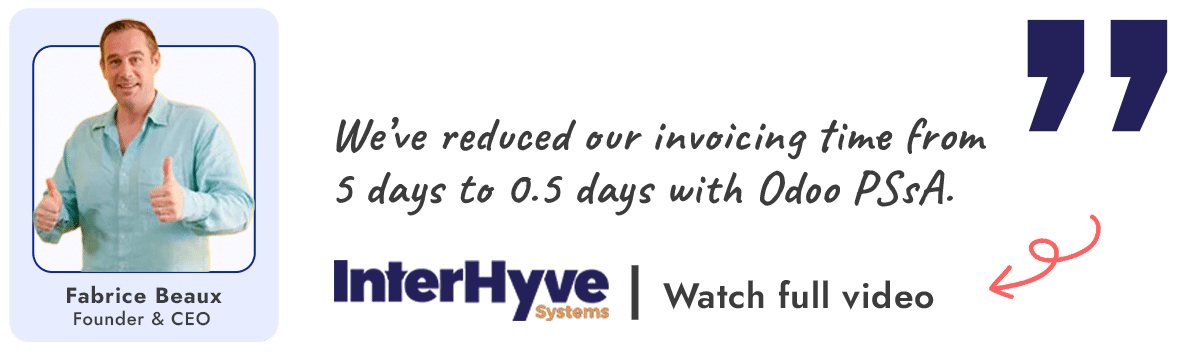
This isn’t another hypothetical proof of concept- that’s the success story of our clients- a Geneva-based IT and cloud services provider, InterHyve.
Modern ERP Software: Tips for Successful Implementation
A next-generation ERP is not a plug-and-play product; it’s a strategic operating model. Successful rollouts follow clear principles:
- Start with Objectives, Not Modules. Define outcomes: faster quote-to-cash, inventory accuracy, compliance visibility, and map ERP functions to them.
- Clean and Consolidate Data Early. Migration is not technical; it’s organizational discipline.
- Phase the Rollout. Deliver measurable value in 60- to 90-day increments to sustain momentum.
- Empower End Users. Train functional leads to own configurations; IT should enable, not gatekeep.
- Review Continuously. Treat ERP as a living system, iterate quarterly based on metrics, not anecdotes.
With this mindset, the ERP stops being an IT asset and becomes a business-performance engine.
Modern ERP isn’t just about automation, it’s about intelligence, adaptability, and alignment.
By integrating data, workflows, and AI into one ecosystem, organizations gain operational visibility that directly fuels growth.
Platforms like Odoo 19 demonstrate how a composable, AI-augmented ERP can unify customer engagement, supply chain efficiency, and financial control without the overhead of traditional systems.
For leaders planning ERP modernization, the question is no longer “Should we move?” but “How fast can we capture the value?”
Ready to transform your business with next-gen ERP software?
Let’s schedule a consultation call!