The best ERP for Auto Parts Distributors runs the whole business on one database, from product catalog with fitment to order fulfilment and accounting.
Epicor does this for large enterprises at enterprise prices. Acumatica, NetSuite and Business Central are good general ERPs with no automotive aftermarket depth. Odoo, with an aftermarket layer (as customized by Aktiv Softare- Odoo Silver Partner), gives independent distributors and wholesalers everything under one roof, with the flexibility to shape it and published pricing from about $25 per user per month. Budget $50,000 to $150,000 in year one for 20 to 50 users.
TL;DR
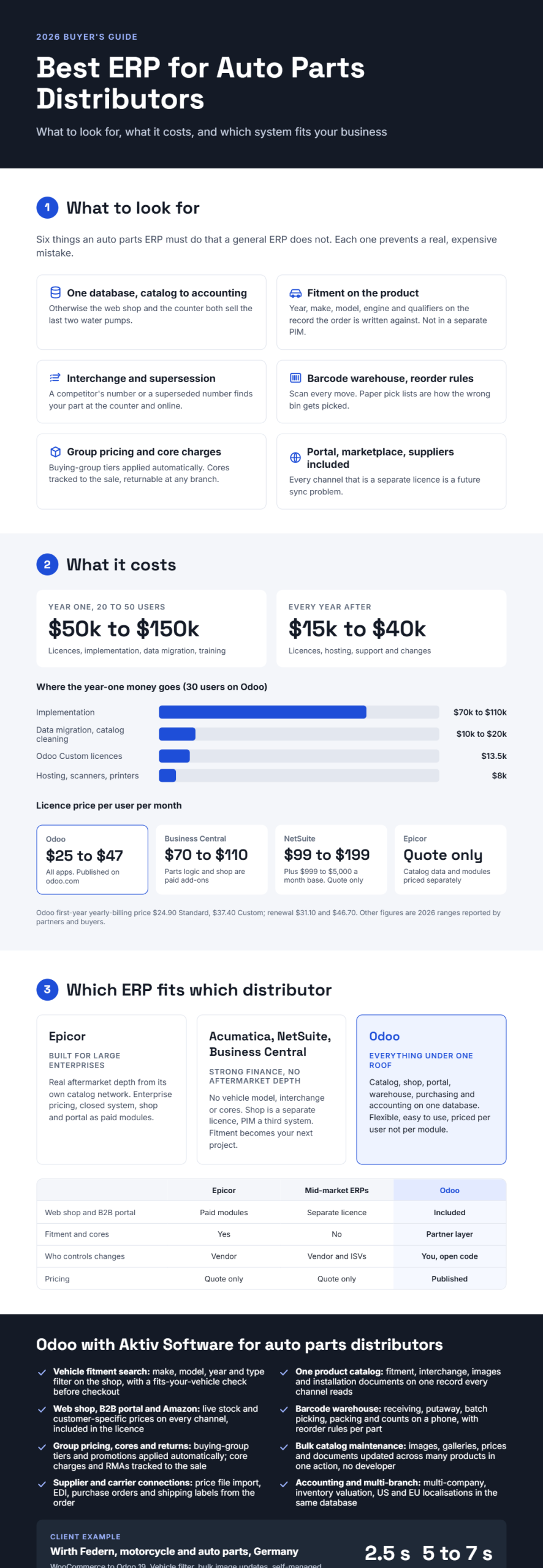
What to look for in an ERP for Auto Parts Distributors?
Everything from catalog to fulfilment in one database
The product record, the web shop, the dealer portal, the counter, the warehouse, purchasing and accounting must read the same data. Not synced copies. When the web shop reads a nightly stock export, it sells the last two water pumps an hour after the counter did. One database is the requirement that makes the other four possible.
Fitment on the product, not in a separate PIM
Fitment is the rule that decides whether an order is right or wrong, so it has to live on the record the order is written against. The Frost & Sullivan aftermarket brief (December 2025) recommends starting with a PIM, adding a digital asset manager, then a catalog, then connecting to the ERP.
That suits a national brand with a catalog team. For a distributor it is four systems and four sync jobs, and a fitment fix made on Friday reaches the shop after the weekend export.
What to look for: year, make, model, submodel and engine on the product, with qualifiers (the brake kit that fits 2015 to 2020 F-150 except the heavy-duty payload package); a vehicle selector on the shop; a basket check; and returns with a “did not fit” reason that flag the record. Interchange and supersession belong here too, so a competitor’s number or a superseded number finds your part.
Inventory and warehouse that run on a scanner
How to manage auto parts inventory efficiently comes down to four things: one quantity per part per location, reorder rules by movement class with seasonal adjustment, barcode scanning on every stock move, and carrier labels generated from the order.
Auto parts inventory management software and auto parts warehouse management software that still prints pick lists is where two lines get picked from the wrong bin because the part numbers differ by one character.
Pricing by customer group, and core charges that follow the part
Buying-group tiers by brand, dated promotions and rebate accruals must apply automatically on every channel, or a sales admin keys the wrong tier and the invoice goes out $380 light. Core charges must be a tracked liability linked to the original sale, returnable at any branch, or a $45 alternator core gets refunded twice.
Supplier and channel connections
Supplier price file import, purchase orders by EDI or structured file, marketplace connectors (Amazon at minimum), and a B2B portal where trade customers see their own prices, live stock and invoices. Every connection that is a separate licence or a separate vendor is a future sync problem.
The checklist, in one table:
| Look for | What goes wrong without it |
| One database from catalog to accounting | Web shop and counter both sell the last two water pumps |
| Fitment with qualifiers on the product | Brake kit ships to a heavy-duty F-150 it does not fit |
| Interchange and supersession | Counter cannot match a competitor’s part number |
| Barcode warehouse with reorder rules | Wrong bin picked; fast movers run out, slow movers pile up |
| Group pricing and core tracking | Wrong tier invoiced; core refunded at two branches |
| Portal, marketplace and supplier connections included | Each channel becomes a separate project and licence |
Which ERP is best for auto parts distributors?
ERP software for automotive distributors and wholesalers are built for three different buyers.
Epicor: built for large enterprises
Epicor Vision and Epicor Eagle have served the US aftermarket for decades, with catalog, interchange and fitment from Epicor’s own data network.
That depth is real. So is the cost: quote-only pricing, a closed system, web shop and dealer portal as separately priced modules, every change routed through the vendor.
Epicor fits a national warehouse distributor with an IT department and a multi-year budget. For an independent distributor with 10 to 100 users, the licence alone can exceed a complete Odoo project.
Acumatica, NetSuite, Business Central: Mid-Market ERP Software
Good mid-market ERPs for accounting, purchasing and multi-entity reporting. None has a vehicle model, interchange, supersession or core tracking. The web shop is a separate licence (SuiteCommerce for NetSuite, ISV add-ons for Business Central) and a PIM becomes a third system. Distributors who choose them get a clean back office, then start a second project for fitment and a third for eCommerce, and end up with the disconnected stack they were trying to leave.
Odoo: everything under one roof, shaped to the business
Odoo gives a distributor the product catalog, web shop, B2B portal, inventory, barcode warehouse, purchasing, accounting, CRM and marketplace connectors as one suite of applications on one database, under one published licence. It fits independent distributors, wholesalers and importers for three reasons:
- Flexibility. Open, modular code, so the aftermarket layer (fitment, interchange, cores, group pricing) is built into the same product record, and you own it
- User friendliness. Counter, warehouse app and back office share one modern interface; staff learn one system instead of four
- Affordable, scalable pricing. One per-user price covers every app; adding a branch, a marketplace or a portal does not add a licence line
ERP Software Comparison for Auto Parts Distributors in 2026
| Epicor | Acumatica, NetSuite, Business Central | Odoo | |
| Built for | Large enterprise distributors | General mid-market finance and distribution | Independent distributors, wholesalers, importers |
| Aftermarket depth | Yes, via Epicor data network | No | Via partner layer on the product model |
| Web shop and B2B portal | Separate modules | Separate licence or ISV | Included |
| Catalog to fulfilment in one database | Yes | After integration projects | Yes |
| Flexibility to change | Vendor-controlled | Vendor plus ISVs | Open code; no vendor lock in and highly customizable |
| Ease of use | Legacy screens | Varies by module | One interface across counter, warehouse, office |
| Pricing | Quote only, enterprise scale | Quote only; add-ons extra | Published, about $25 to $37 per user per month |
What automotive ERP software costs in 2026?
For a distributor with 20 to 50 users, automotive ERP software cost is $50,000 to $150,000 in year one, including licences, implementation, data migration and training, then $15,000 to $40,000 a year. Epicor and NetSuite sit at the top of that range or above it. Odoo sits at the bottom, and the difference is almost entirely licence cost.
Licenses Cost
Odoo publishes its prices: Standard about $24.90 and Custom about $37.40 per user per month (USD, annual billing), all apps included. An aftermarket layer needs Custom. Business Central publishes a per-user list price, with parts logic and eCommerce as paid ISV add-ons. Epicor, NetSuite and Acumatica are quote only, typically a platform fee plus per-user or consumption fees, with commerce and catalog as separate lines.
Implementation and data migration
This is where the money goes on every platform. Published partner estimates for Odoo put 25 users at $35,000 to $80,000 over 10 to 14 weeks and 50 users at $60,000 to $150,000. Enterprise and NetSuite partners quote a similar or higher band at higher hourly rates. Three things move the number: how clean your fitment data is today, how many pricing rules exist, and how many marketplaces, EDI partners and supplier feeds you connect. Add two to four weeks of data work for a QuickBooks exit, more for 15 years of legacy history.
Cost Comparison for ERP for Auto Parts Distributors
| ERP | Licence model | Indicative price (USD) | 30 users, indicative annual |
| Odoo Standard | Per user, all apps, Odoo Online hosting | $24.90 per user per month first 12 months, then $31.10 | $9,000 then $11,200 |
| Odoo Custom (needed for an aftermarket layer) | Per user, all apps, plus Odoo.sh or on-premise | $37.40 per user per month first 12 months, then $46.70; Odoo.sh hosting $700 to $6,000 a year | $13,500 then $16,800, plus hosting |
| Dynamics 365 Business Central | Per user, Essentials or Premium; parts logic and eCommerce via paid ISV add-ons | Essentials about $70 to $80, Premium about $110 per user per month | $25,000 to $40,000 before add-ons |
| NetSuite | Base platform fee plus per-user; SuiteCommerce and advanced inventory as separate modules | Base $999 to $5,000 a month; full users $99 to $199 per user per month | $48,000 to $130,000 before commerce |
| Acumatica | Consumption-based (transactions and resources), unlimited users; add-ons per partner | Reported from roughly $15,000 to $30,000 a year for small deployments, rising with volume | $20,000 to $50,000 |
| SAP Business One | Per user, cloud or perpetual | Reported $80 to $150 per user per month cloud | $29,000 to $54,000 |
| Epicor Vision / Eagle | Per user or per site, plus catalog data subscription, plus eCommerce and portal modules | Enterprise quote; catalog data and modules priced separately | Not published; buyers report it exceeds the mid-market ERPss |
Choosing ERP for Auto Parts Distribution Business
For a national distributor already in Epicor’s data network, Epicor is the safe choice. For a group that already runs NetSuite or Acumatica, extending it is defensible if fitment and eCommerce are budgeted as separate projects.
Everyone else, which is most independent distributors, wants one system that runs the business from catalog to fulfilment, can be shaped to how parts are sold, and does not cost enterprise money.
That is what Odoo with an aftermarket layer delivers, and this is its honest status against the checklist, as Aktiv Software implements it:
Why Choose Odoo for Auto Parts Aftermarket Business?
| Look for | Odoo standard | Aktiv aftermarket layer | Status |
| One database from catalog to accounting | Website, portal, POS, Amazon connector, warehouse, accounting on one quant and one ledger | Not needed | Standard |
| Fitment with qualifiers | Attributes only, no vehicle model | Vehicle master, fitment records, shop selector, basket check | Selector live at clients; full engine in development |
| Interchange and supersession | Alternative products, vendor codes | Cross-reference table, supersession redirect | In development |
| Barcode warehouse and reorder rules | Receiving, putaway, batch picking, packing, counts, min/max and forecast replenishment | Not needed | Standard |
| Group pricing and cores | Pricelists by customer, brand, quantity, date; returns and refunds | Rebate accruals; core liability, any-branch return, reason codes to fitment | Pricing standard; cores in development |
| Portal, marketplace, supplier connections | Portal and Amazon connector included; pricelist import, EDI import, carrier connectors | Vendor file loaders | Standard plus configuration |
| Bulk catalog maintenance | Mass edit, import/export | Bulk image and document updates (a client went from one product at a time to a batch in 5 to 7 seconds) | Live at clients |
| ACES and PIES exchange | Not in Odoo | Import/export mapped to product model | Roadmap, not live |
Real Use Case of a German motorcycle and automotive parts seller using Odoo
Client- Wirth Federn
Platform- Odoo
Implementation Partner- Aktiv Software
Situation before using Odoo:
Their WooCommerce shop had slowed as the catalog grew, customers could not search by their vehicle, images were edited one product at a time, installation PDFs needed a developer to change, and the company’s own products were buried in search results behind other suppliers.
Results after moving to Odoo:
Aktiv moved the complete shop to Odoo 19, kept the design and navigation so returning customers noticed no major changes.
Built what the business needed on the same product record:
- A make, model, year and type vehicle filter, bulk image and gallery updates, shipping charges by payment method and cart weight
- Installation PDFs the team attaches to product groups itself
- Search ranking that lists Wirth Federn’s own products first
- Old URLs were redirected and search rankings monitored for three months after go-live.
Every page now loads within 2.5 seconds, a batch image update takes 5 to 7 seconds, and the team changes shipping rules, documents and search order without development work.
Wirth Federn’s WooCommerce to Odoo Migration Story
Frequently asked questions about Auto Parts Distribution ERP Software
Best ERP software for auto parts distributors?
For most independent distributors and wholesalers: Odoo with a partner aftermarket layer, for single-database and cost reasons. For large enterprise WDs in Epicor’s data network: Epicor Vision.
How much does automotive ERP software cost?
$50,000 to $150,000 in year one for 20 to 50 users, then $15,000 to $40,000 a year. Licence cost is the main difference between platforms; implementation costs are closer than people expect.
Best inventory software for auto parts wholesalers?
The one that gives counter, web shop and portal the same live quantity and runs the warehouse on a barcode app. In Odoo both are standard; in NetSuite and Acumatica the shop is a separate licence.
ERP software for small and medium auto parts distributors
For 5 to 100 users, Odoo Standard or Custom is usually the best value: web shop, inventory, purchasing and accounting from about $25 per user per month, implementation from roughly $15,000 to $35,000. A small distributor leaving QuickBooks typically needs product and customer import, the barcode app on existing phones, and the web shop on the same database. Fitment is added once the catalog is clean.
ERP software for automotive parts wholesalers with a dealer portal?
Customer-specific pricing, live stock, order history and invoice download in the portal. Odoo includes the portal in the licence; Epicor and the mid-market ERPs charge for it.