How do you make a sign shop move from isolated tools to Odoo, keeping a cleaner flow from customer inquiry to completed installation and billing.
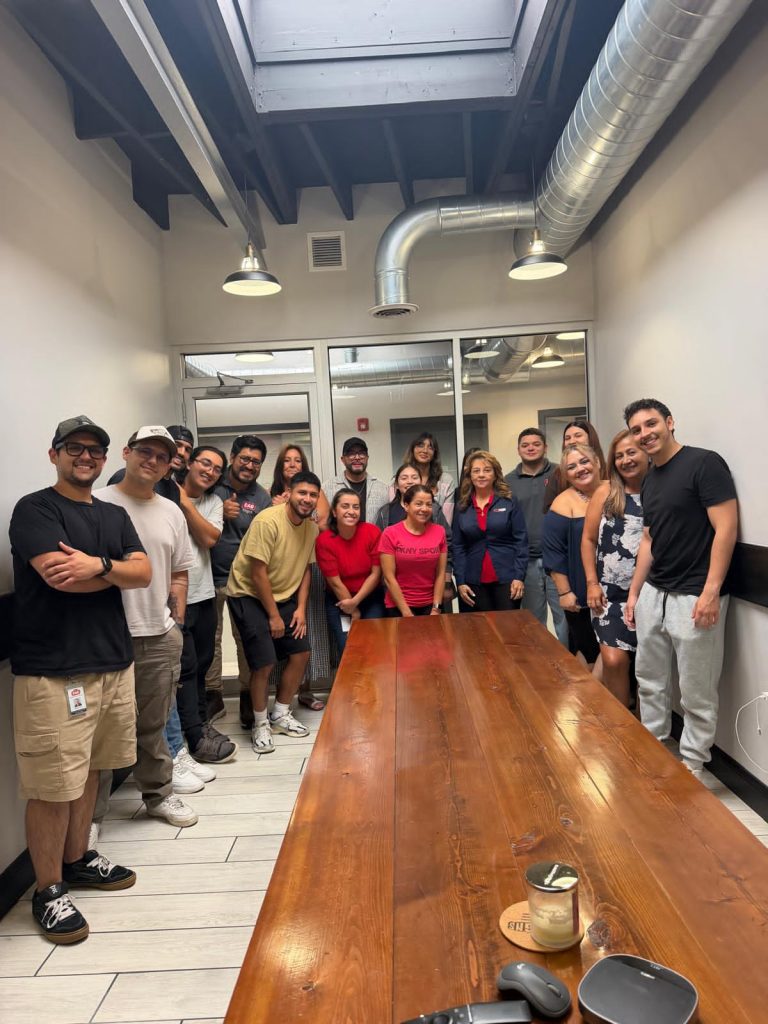
There is something especially rewarding about seeing a system go live after months of discovery sessions, process discussions, configuration, testing and collaboration between two teams.
For us, the recent Phase 1 go-live at CAD Signs was one of those moments.
It marked an important step in how their team will manage the day-to-day work behind a signage project, from the first customer conversation to quoting, project coordination, field activity, documentation and finance.
And this was not simply a matter of replacing one piece of software.
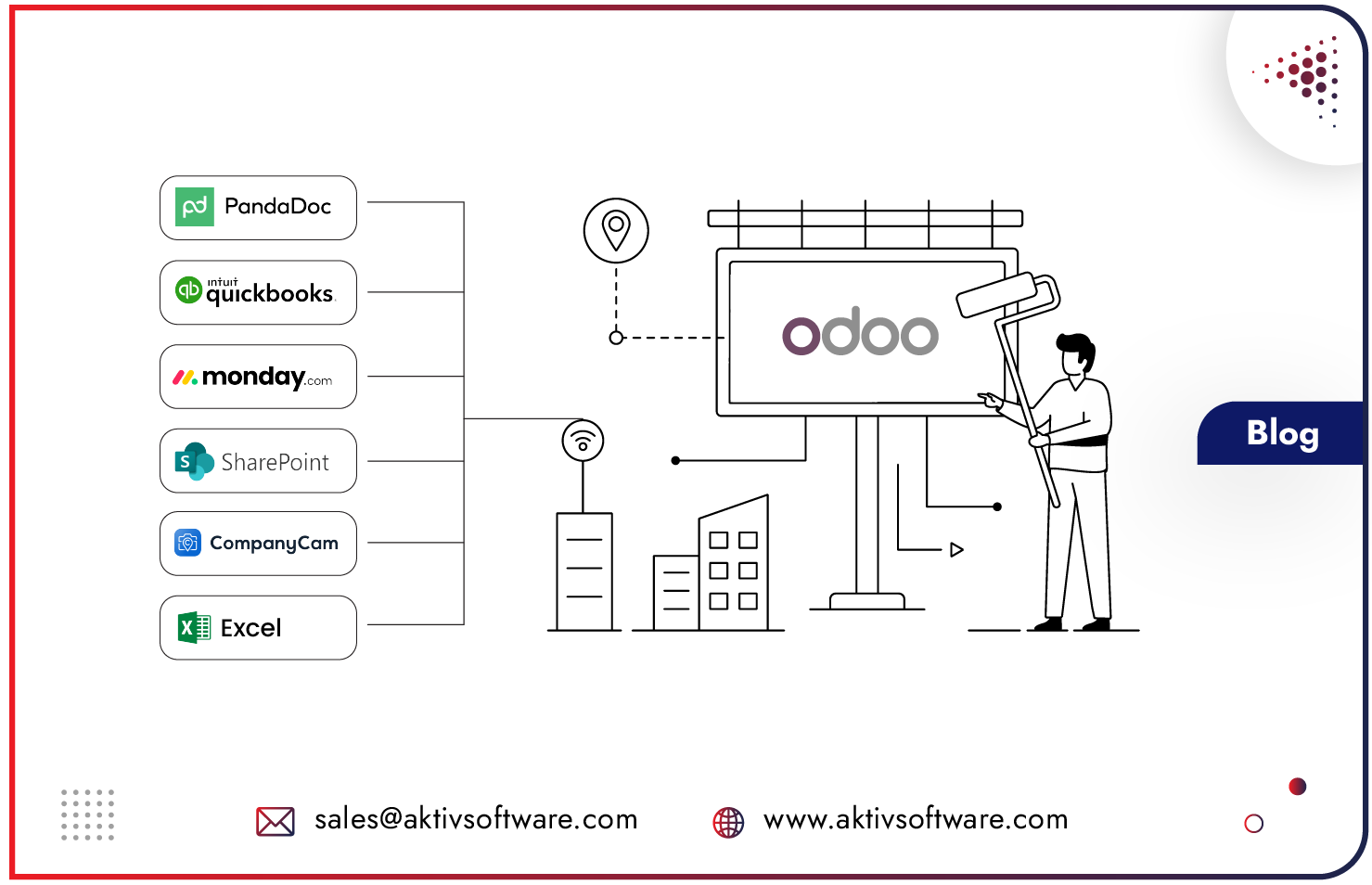
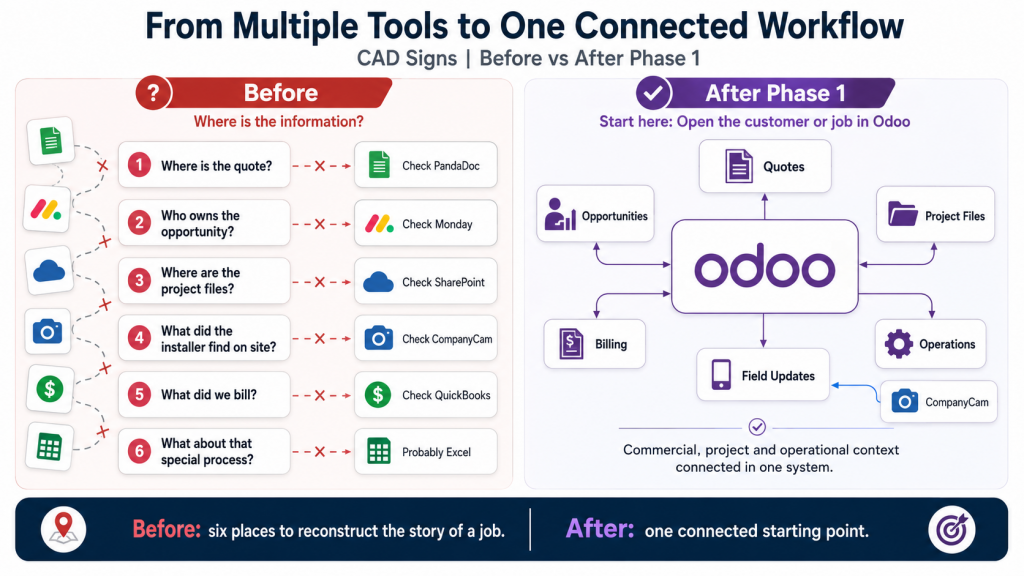
It was that a growing signage business had started moving away from a way of working where a single job could be spread across QuickBooks, Monday.com, PandaDoc, SharePoint, CompanyCam and Excel.
With Odoo, CAD Signs has now started moving toward a connected operating environment where sales, project teams, field operations, documents and finance can work around the same customer and the same job.
How CAD Signs Replaced a Patchwork of Tools with One Sign-Job Workflow?
For a Sign Company, the Sales Handoff Should Not Start in Monday.com and Restart in PandaDoc
Replacing Monday.com + PandaDoc with Odoo CRM and Sales
Before Odoo, CAD Signs used Monday.com to manage leads and opportunities, while PandaDoc was used to prepare quotations and sales documents.
That meant the commercial journey was split before the job had even been won.
A salesperson could be working with the customer in Monday.com, but once it was time to prepare the quote, the process moved into another system.
For a signage business, that separation matters because the quote often contains more than a price.
It can carry:
- project scope,
- site details,
- sign type,
- dimensions,
- installation requirements,
- customer expectations,
- revisions,
- and other information the project team will eventually need.
With Odoo, the objective was to keep that journey connected:
Lead → Opportunity → Quotation → Confirmed Order
The customer and project context no longer need to be recreated simply because the job moves from sales into quoting.
It can involve site surveys, measurements, drawings, permitting, approvals, fabrication, subcontractors, scheduling, equipment, field crews, installation, completion photos and final billing.
And every one of those stages depends on information created earlier in the job.
For a Sign Company, the Sales Handoff Should Not Start in Monday.com and Restart in PandaDoc.
Odoo Project Management for Signage Industry
Replacing Monday.com Project & Task Management with Odoo Project
For many businesses, project management begins after the sale.
For a sign company, that is when much of the real work starts.
A confirmed signage job may still require:
site surveys → artwork or drawings → approvals → permitting → fabrication coordination → installation planning → site work → completion
CAD Signs had been using Monday.com for projects and tasks.
The challenge was that the project lived separately from the sales process that created it.
Odoo changed that relationship.
The project could now sit much closer to the original customer, quote and confirmed scope.
That means the project manager has more context around what was sold, what needs to happen next and which customer the work belongs to, without rebuilding that story elsewhere.
For CAD Signs, replacing Monday.com was therefore not simply about moving tasks into another task board.
It was about making sales and project execution part of the same sign-job lifecycle.
Sign Drawings, Permits and Project Files Should Follow the Job, not Live in a Separate SharePoint Folder.
Replacing SharePoint-Based Project File Management with Odoo Documents
Sign projects create a large amount of documentation.
Site photos. Measurements. Customer artwork. Drawings. Permit documents. Revisions. Installation information. Supporting files.
Previously, CAD Signs relied on SharePoint to manage project-related files and documents.
SharePoint can store those files well.
The operational problem comes when the employee working on the job has to leave the job record, navigate another folder structure and determine which file is the latest one.
With Odoo, the aim was to bring documents closer to the business record they actually belong to.
Odoo CompanyCam Integration
CAD Signs was already using it for field-service and site-related work, and that workflow had practical value for employees working away from the office.
For a signage contractor, field photos can document:
- site conditions,
- measurements,
- mounting surfaces,
- access requirements,
- installation progress,
- completed work,
- and issues discovered on site.
Those photos are not just images. They are part of the project record.
Instead of forcing the field team away from a tool that worked for them, Aktiv built a custom CompanyCam API connection with Odoo.
The purpose was to close the gap between the people managing the project and the people physically working at the site.
This is an important part of the CAD Signs story because moving to one business platform does not always mean removing every specialist application.
Migration from QuickBooks to Odoo for a Sign Company’s Accounting
CAD Signs had been using QuickBooks for accounting. But the operational activity leading up to accounting was happening elsewhere.
Sales had its information. Projects had theirs. Field work had its updates. And accounting ultimately received the financial result.
That creates a common divide between: the people who know what happened on the job
and the system that knows what was billed.
Moving financial processes into the broader Odoo environment gives the business an opportunity to connect the commercial and operational side of a job with its financial outcome.
For a project-driven signage company, that relationship is important.
Instead of finance being treated as the last isolated step, the longer-term operating model can connect: Customer → Quote → Project → Work Completed → Billing
What actually changed for CAD Signs after Sign Shop Management Software Phase 1 went live?
CAD Signs now has an operational backbone where significantly more of the job can move as one connected record instead of a series of disconnected handoffs.
Why this matters especially for growing sign companies?
Sign businesses have an unusual mix of office work, manufacturing-style work and field service.
- The estimator is thinking about scope and price.
- The project manager is thinking about deadlines and dependencies.
- The permit team is thinking about approvals and code.
- Fabrication is thinking about what needs to be built.
- The installer is thinking about site conditions, access, equipment and safety.
- Finance is thinking about what can be invoiced and collected.
- And the customer just wants to know when the sign will be installed.
That’s why generic task management tends to become strained as a sign company grows.
The industry’s own software vocabulary reflects this: estimating, artwork approval, production scheduling, fabrication, purchasing, installation, field work, job costing and closeout are increasingly treated as parts of one sign-job lifecycle rather than isolated functions.
The software needs to follow the job. Not the department.
Is your signage business still relying on multiple tools to manage one job?
If your team is moving between spreadsheets, accounting software, project boards, document folders, quoting tools, and field apps just to understand where a job stands, it may be time to rethink the workflow.
At Aktiv Software, we help sign and project-based businesses bring sales, quoting, projects, documents, field operations, and finance into one connected Odoo environment—without losing the processes that already work well.
Bring us one real job from inquiry to final billing, and we’ll help you identify where the handoffs, duplicate work, and visibility gaps are happening.