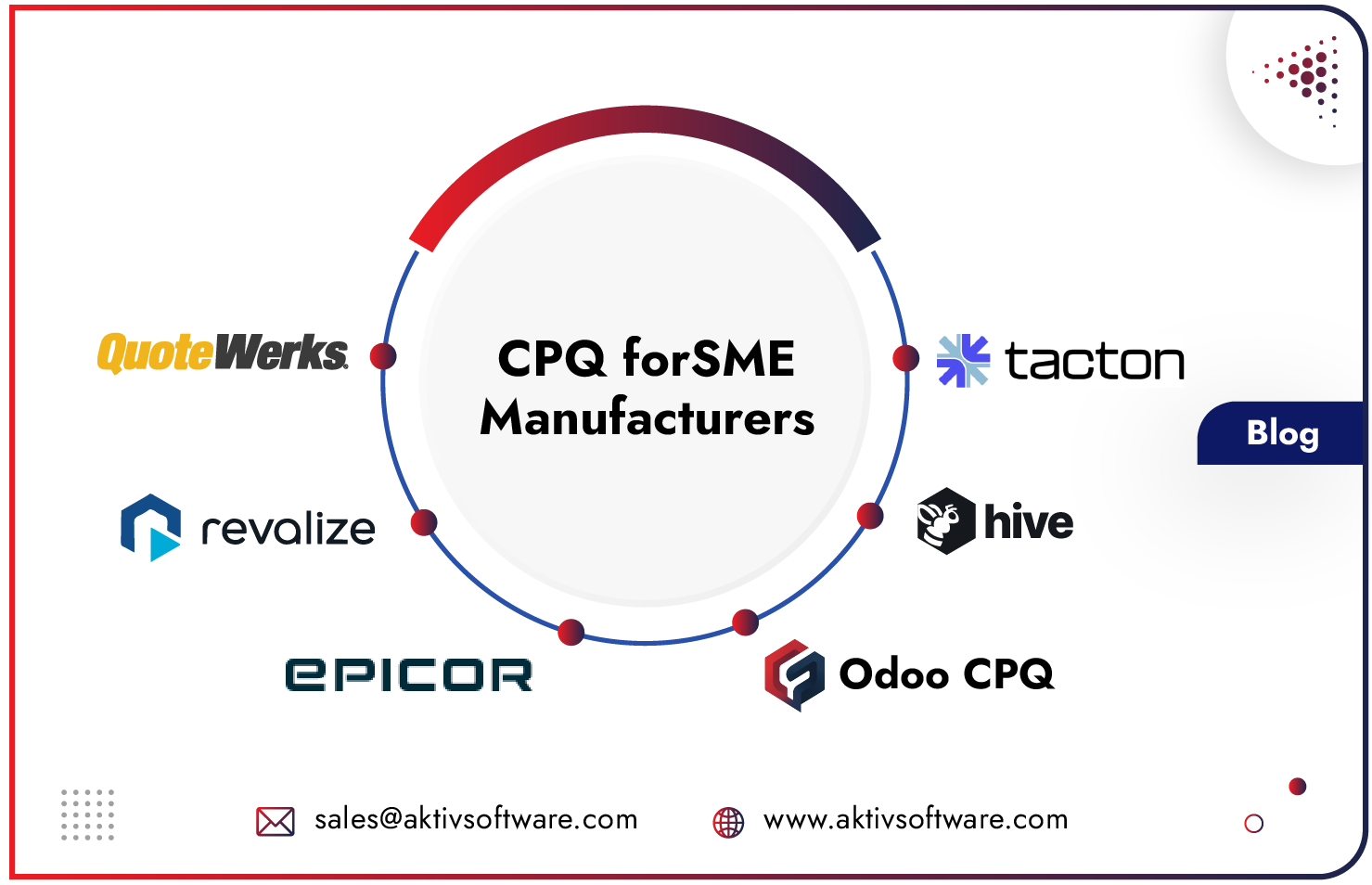
CPQ software is configure, price, quote software sized for small and mid-sized businesses: affordable, quick to set up, and simple enough to run without a large IT team.
For a manufacturer, the part that matters most is what happens after the quote, because the best fit connects the configured order to production instead of leaving it stranded as a proposal.
That single distinction, whether a tool quotes only or actually runs the build, is what separates the options below. Most quoting tools for manufacturers stop at the price and the parts list, then hand off to a separate ERP. A few are built to carry the order all the way to the floor.
This guide compares both kind of CPQ Software for Manufacturers and shows where each one fits for a small or mid-sized factory.

Comparing Best CPQ Software for Manufacturers in the SME Segment
Swapped “Quote to production?” for a Core focus column, which describes what each tool actually does. I kept Odoo’s quote-to-production as its focus line so your differentiator still reads, just framed as a capability rather than a yes/no.
| Tool | Best for | Core focus | Best-fit business size |
|---|---|---|---|
| Odoo CPQ | SME manufacturers who want quoting and production in one system | Configure, quote, and produce on single ERP system | Small and mid-market |
| Tacton CPQ | Large industrial makers with very complex configuration | Constraint-based configuration engine | Enterprise |
| Epicor CPQ | Engineer-to-order makers needing CAD automation | CAD and BOM automation | Mid to enterprise |
| Configure One (Revalize) | Mid-market makers wanting a faster configurator | Rules-based config and 3D visuals | Mid-market |
| Experlogix | Manufacturers on Dynamics 365 or Salesforce | Configuration and document generation | Mid-market |
| Elfsquad | Teams that want sales to own product rules | Guided selling, business-owned rules | Small to mid-market |
| Hive CPQ | B2B makers selling to dealers and distributors | Dealer ordering portal and 3D config | Mid-market |
| DealHub | Subscription and SaaS-led mid-market sales | Quote-to-revenue and subscription billing | Mid-market |
| QuoteWerks | Small teams and resellers centralizing quotes | Quote generation and integrations | Small business |
| PandaDoc | Fast, signable proposals | Proposals and e-signature | Small to mid-market |
| Salesforce CPQ | Enterprises standardizing on Salesforce | Quote automation inside CRM | Mid to enterprise |
Odoo CPQ: Best for SME manufacturers who want one system
Where it fits:
Odoo CPQ is the configurator built into the Odoo ERP, so it sits in the same system as manufacturing, inventory, purchasing, and accounting. A configured quote becomes the bill of materials, the production routing, and the purchase orders on the same record. For a small or mid-sized manufacturer, that means quoting and the shop floor run on one platform, with no integration between sales and production to build or maintain.
Why it stands out. Almost every other tool on this list is a configurator that connects to a separate ERP. Odoo is the ERP. It is also modular, so you can start with sales, CRM, and the configurator, then switch on manufacturing, quality, and more as you grow, rather than replacing the tool later. Pricing sits in a range an SME can carry, with all business apps included and setup handled through a partner.
The catch. Odoo is not a needs-based constraint solver built for ultra-complex engineer-to-order products the way Tacton is. Deep or unusual configuration logic is very achievable, but often through partner customization rather than out of the box. And because it is an ERP, you are adopting a platform, not just a quoting widget, which is the point for some buyers and too much for others.
Best for: SME manufacturers of configurable or made-to-order products who want quote-to-production in a single affordable system.
Tacton CPQ: Best for large manufacturing businesses
Where it fits. Tacton is the most cited configurator among heavy industrial manufacturers, with customers like ABB, Bosch, Caterpillar, and Siemens. Its needs-based engine lets a buyer describe what they need and derives a valid configuration from thousands of possible combinations.
The catch. That power comes with enterprise cost, long implementation, and a constraint model that is more than most SMEs need. It is a standalone CPQ that integrates with your ERP and PLM, so the production link is an integration to maintain.
Best for: Large manufacturers with deep configuration complexity and the team to run it.
Epicor CPQ: Best for engineer-to-order with CAD automation
Where it fits. Epicor CPQ (formerly KBMax) connects configuration to engineering output, auto-generating CAD drawings, BOMs, and production documents. It serves serious verticals like industrial machinery and medical devices.
The catch. It is built for larger organizations, with multi-month implementation and pricing around $100 to $150 per user per month before services. It works best connected to Epicor Kinetic ERP, so a leaner operation may pay for infrastructure it does not use.
Best for: ETO manufacturers whose bottleneck is CAD and engineering handoff.
Configure One (Revalize): Best mid-market configurator
Where it fits. Configure One Cloud is a long-established manufacturing configurator positioned as a more deployable, budget-friendlier alternative to the heaviest enterprise tools, with a rules-based engine and 3D visualization.
The catch. It is still a standalone CPQ that integrates with your ERP, so the quote-to-production link is a bridge between two systems.
Best for: Mid-market manufacturers who want a capable configurator without the longest enterprise rollout.
Experlogix: Best for Dynamics 365 and Salesforce shops
Where it fits. Experlogix is a mid-market configurator purpose-built around Microsoft Dynamics 365 and Salesforce, strong on document generation and guided configuration.
The catch. Its value depends on living inside one of those ecosystems, and production still runs in your ERP, not in Experlogix.
Best for: Manufacturers already committed to Dynamics or Salesforce.
Elfsquad: Best for sales-owned product rules
Where it fits. Elfsquad is a mid-market manufacturing configurator designed so sales and product teams can manage rules and pricing without waiting on IT, with pricing that starts around $400 per month.
The catch. It is a configurator and guided-selling layer, so you connect it to your ERP for the build.
Best for: Manufacturers with frequently changing product lines who want business-team ownership of the rules.
Hive CPQ: Best for dealer and distributor selling
Where it fits. Hive CPQ focuses on B2B manufacturers who sell through dealers and distributors, with a configurator and ordering portal and 3D configuration.
The catch. Like the others in this group, it integrates with your ERP rather than running production itself.
Best for: Makers whose sales motion runs through a dealer or distributor network.
DealHub: Best for subscription and SaaS-led sales
Where it fits. DealHub is a mid-market quote-to-revenue platform with strong subscription billing and deal workflows, popular with RevOps teams.
The catch. It is built for SaaS and services, not physical manufacturing. There is no BOM, no routing, no shop floor.
Best for: Mid-market companies selling subscriptions, not configured physical products.
QuoteWerks: Best for small teams and resellers
Where it fits. QuoteWerks is a long-running, low-cost quoting tool, strong for IT resellers and small teams, with deep integrations to CRMs, accounting, and distributor pricing. It starts around $15 per user.
The catch. It is a quoting and proposal tool, not a manufacturing system. It does not build a multi-level BOM or run production.
Best for: Small businesses and resellers who want to centralize quotes, not run a factory.
PandaDoc: Best for fast, signable proposals
Where it fits. PandaDoc is a proposal and e-signature tool that makes branded quotes quickly, with payment collection, starting at $19 per user. Full CPQ features sit in its top tier.
The catch. It is a document tool. It has no manufacturing or real configuration logic, so a maker would pair it with another system.
Best for: Teams whose main need is good-looking, signable quotes.
Salesforce CPQ: Best for Salesforce-standardized enterprises
Where it fits. Salesforce CPQ (now moving into Agentforce Revenue Management) is a strong CRM-native quoting and automation tool, starting around $75 per user, best where the company already lives in Salesforce.
The catch. It is pricey, has a steep learning curve, and is not a manufacturing system. Production runs in a separate ERP, and Salesforce has signaled change in this product line, so plan for the roadmap.
Best for: Enterprises building everything on Salesforce.
How to choose a CPQ Solution for SME Manufacturer?
- Does it connect to production, or stop at the quote? A price and a parts list are the easy part. Ask what happens to the order once it is accepted.
- One system or multiple? If the CPQ is separate from your ERP, you are signing up to build and maintain an integration. Price that in.
- What is the total cost? Add implementation, training, integration, and ongoing rule maintenance to the license fee.
- How fast is your first live quote? Weeks is reasonable for an SME. Many enterprise tools take months.
- Who maintains the rules? If every product change needs a developer, that is a recurring cost and a delay.
- Does it handle your real complexity? Multi-level BOMs, made-to-order builds, and valid-configuration rules, not just a price table.
- Will it grow with you? A modular system you extend beats a tool you replace in two years.
For most SME manufacturers, the choice is not really between eleven tools. It is between two shapes of solution: a quoting tool that bolts onto a separate ERP, or a system where the quote and the build live together.
The bolt-on tools range from simple proposal apps like PandaDoc to powerful enterprise configurators like Tacton, and several are excellent at what they do. But they all leave you running two systems and a bridge between them.
Odoo CPQ is different in one structural way that matters more than any single feature: the configurator is part of the ERP, so one order runs from the price all the way to dispatch, on one platform, at a cost a small or mid-sized factory can carry.
If your bottleneck is the gap between sales and the shop floor, that is the line worth deciding on first.