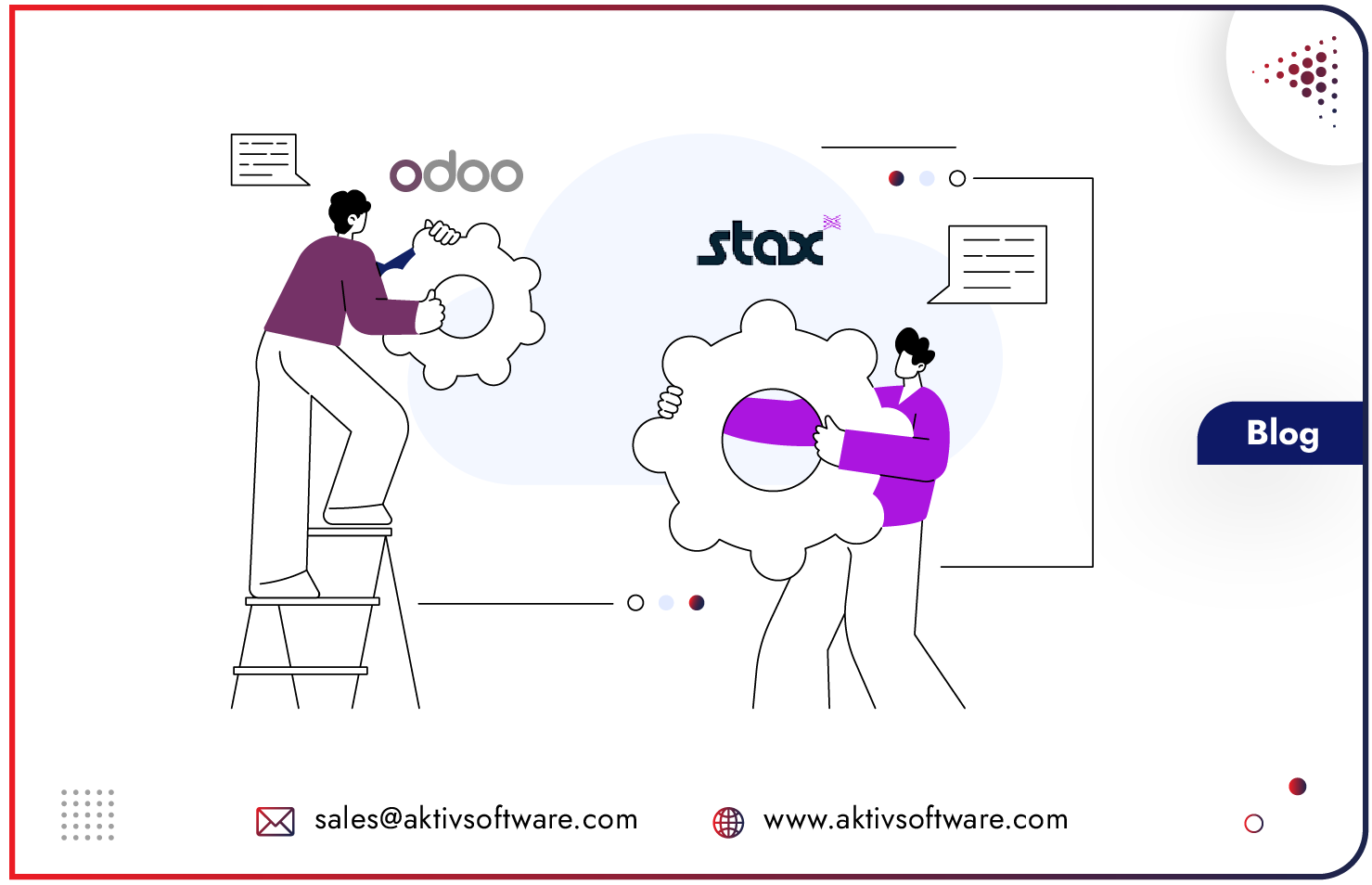
An Odoo Stax integration lets you take card payments at the counter, over the phone, and online directly against your Odoo invoices, so payments are captured, applied, and reconciled inside the same system you run the business on.
Stax still processes the card. Odoo becomes the place the payment actually happens, tied to the right invoice and the right customer.
Most businesses using Stax run it beside their ERP, not inside it. That gap is small until you count how much manual work it creates every day.
What Problems Do Stax Users Face Without ERP Integration?
Without an integration, Stax and your ERP are two separate systems that someone has to keep in agreement by hand. That creates a familiar set of problems:
- Payments taken beside the system. Cards are charged in Stax’s virtual terminal or on a counter reader, then the invoice is marked paid in the ERP separately.
- Manual reconciliation. Every Stax transaction has to be matched back to an invoice after the fact.
- Double entry. The same payment is recorded twice, once in Stax and once in accounting.
- Card data handled by staff. Numbers read over the phone and keyed in, which is a security and PCI risk.
- No card on file tied to the account. A returning business customer is treated as a stranger, and a company card cannot be reused across that company’s contacts.
- A counter reader that knows nothing. The card machine is not connected to the invoice being paid.
- Surcharges handled by hand. With the real risk of surcharging in a state where it is not permitted.
- Recurring accounts charged manually. Someone works through cycle-billed customers every month.
- Refunds, voids, and disputes tracked outside the system. With no record against the original transaction.
- A paid status that disagrees with the ledger. The badge a customer sees and the accounting behind it drift apart.
How does Stax Integration with Odoo work?
It is a full Stax payment provider built on Odoo’s payment framework, so charging a card is a native action inside Odoo rather than a separate task in Stax. Card data is tokenised on the customer’s side, so the actual card number never touches your systems, charges run securely on the server, and Stax confirms each transaction back to Odoo through verified notifications.
The result is that a payment is no longer a thing you do in one system and copy into another. It is one action, on the invoice, in Odoo.
Built in production: Aktiv Software delivered this Stax integration for J2 Blueprint Supply Co., a US reprographics business, as part of their Odoo implementation, bringing counter, phone, and online card payments onto a single platform reconciled against real invoices.
Can a Saved Card Be Used Across a Whole Company Account?
Yes. A card saved against a company can be used by any contact of that company, with the owning company taken from the order rather than guessed from the contact. This matches how business-to-business accounts actually work, where a company card is used by whoever from that company happens to be on the phone.
Saved cards carry their billing address, can be transferred between owners, and hold void, reopen, and dispute records against the original transaction, so the full history of a card and its charges lives in one place.
How Do Counter and Card-Reader Payments Work?
They are launched straight from the invoice, or from the job itself, through a single Pay Invoice action that looks up the invoice or accounts-receivable number and charges either the counter reader or a card already on file. The reader is card-present and in-person, so a walk-in customer is charged against the exact invoice on screen, not a disconnected terminal.
A customer-facing display at the counter shows the charge, with configurable content and an optional step where the customer explicitly confirms before anything is charged. Nothing is taken without the invoice and the amount being the real ones.
How Does Odoo Stax Integration Handle Surcharges and Compliance?
Through a surcharge engine that follows card-industry rules, with a configurable rate, cost rate, and cap, a separate switch for ACH, and per-state blocking where surcharging is not permitted. It also flags a configuration that is internally inconsistent and shows the customer a clear surcharge notice, so a surcharge is never applied where it should not be.
For a business taking cards across multiple states, this removes a genuine compliance risk that manual card handling leaves wide open.
Can It Charge Recurring Accounts Automatically?
Yes. A monthly billing day and an automatic charge scheduler handle accounts that are billed on a cycle, so cycle-billed customers are charged on schedule without anyone working through them by hand each month.
How Does Reconciliation Work if Stax is integrated with Odoo?
Transactions sync from Stax back into Odoo, and card readers are discovered automatically, so reconciliation becomes a comparison rather than a manual exercise. Instead of matching a Stax report to your invoices by hand, the payments are already in Odoo against the invoices they belong to.
Because charging happens on the invoice in the first place, most reconciliation simply does not need to happen. The payment was never separate from the record.
Can Stax Customers Pay Their Invoice Online after Integration?
Yes. A portal Pay Now works for portal customers, with the payment link created for that specific invoice’s customer and amount, so an online payment lands against the correct invoice automatically. A customer can pay at the counter, over the phone, or online, and all three routes settle against the same invoice in the same system.
How Reliable Is the Payment Behaviour after Odoo Stax Integration?
It is verified by an automated test suite rather than assumed use cases. The tests cover charging, tokens, the company-card model, monthly billing, the auto-charge scheduler, card removal, void and reopen, and hardening cases, so payment behaviour is proven before it reaches a real customer. For anything touching money, that matters.
Want to integrated Stax Payment Gateway with Odoo?